
There is Art in Science, and There is Science in Art (Do What You Love - Part 3)
“If you’re having a good time in your own company, it’s a good sign that you’re happy and you enjoy what you do.” -Shubhada
By Phoebe Pineda
Point to Ponder: “Discovery consists of looking at the same thing as everyone else and thinking about it differently.” –Albert Szent-Györgyi
Storyline:
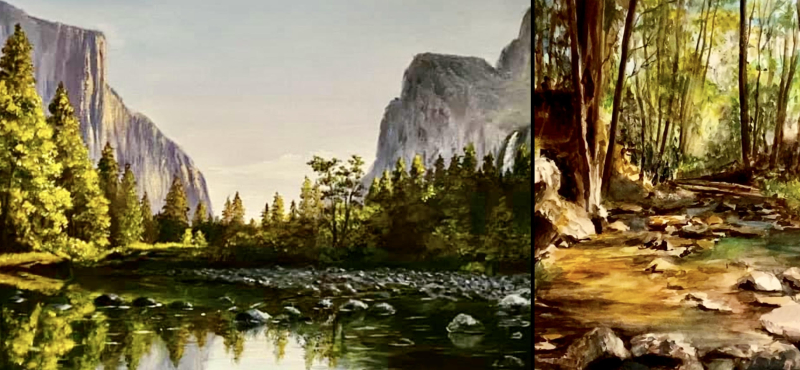
From majestic landscapes to portraits of renowned historical figures, Shubhada Sahasrabudhe’s art captures beauty in all sorts of places.
An engineer by trade, working at one of the world’s largest tech companies, Shubhada grew up in two worlds: art and science. “I lived in an engineering town that manufactured pumps, and my dad worked in research and development,” she says. “But art was in the house all the time. My dad did outstanding sketches and paintings, and we spent our evenings sitting side-by-side with him and watching him work, doing random art projects-Even his engineering drawings.” Growing up close to the process of creation, both at the pump factory and at home, instilled a strong sense of curiosity in Shubhada–“We were told to always be curious, not to stop at what but to ask why”–as well as a strong creative drive: “There was this push to be original,” she says. “My parents told me, ‘You have to create something that belongs to you. You're not an artist or a scientist unless you have contributed.’”
With limited supplies around the house, Shubhada often spent her childhood drawing in dirt roads with a stick which interestingly and unknowingly connected her to sand as a medium which she used years later. “It was like an unlimited canvas,” she says.
Though she now has access to more traditional mediums, such as oil and acrylic, she still enjoys working with less conventional materials. “I’ve always been an experimentalist, so I always try a new technique–anything that stains with a pigment is my medium,” she says. “If I finish my coffee and I have a little left at the bottom, I will use it.” Her sand art in particular has garnered much attention, including a guest appearance on the Nickelodeon show Ryan’s Mystery Playdate.
Despite coming up in a workplace culture where hobbies and leisure time were challenging, Shubhada takes both her engineering and artistic career equally seriously. “I don’t think I’ve ever felt like art and science are distinct things,” she says. “To me they are so blurry and so similar. Yes, there is more system to science, but you see both elements–system and random–in different ways. When I begin a painting, I don’t start with the details: I do the big strokes first to get the basic form and values together, and that defines my painting. That’s exactly how I think of engineering: whenever I look at a problem statement, I look at the broad strokes and ask myself, What am I trying to do? Once I have those pieces, I know how to fill in the minor details. Knowing the end point helps guide your next steps.” Science and engineering also played a major role in Shubhada’s sand art, from constructing the worktable (which Shubhada designed and built herself) to finding the right type of sand: “I went to twenty different beaches to get as many sand samples as possible,” she says.
Though balancing work and life can be challenging, Shubhada says making time to do what she loves is worth every minute. “Painting for hours is meditative,” she explains. “It’s the most neutral feeling you can have, which is so rare in this day and age: not happy, not sad, just neutral and satisfied.” She’s made it a priority to share that feeling with others, whether it’s teaching three and a half hours of back-to-back weekly classes through her art academy or finishing and posting a charcoal portrait every day for 140 days during quarantine. Sketch a Day “I tried to use my art to combat the negativity and sadness,” she says. “If you’re having a good time in your own company, it’s a good sign that you’re happy and you enjoy what you do.”
For her contributions in the field of science, Shubhada recently received an esteem award "Women Engineer of the Year" by American Sociery of Mechanical Engineers. Being recognized in the areas of her profession as well passion demonstrates her commitment to excellence in whatever she takes up.
Reflection:
I’ve always envied creatives who work in math and science: my physics and bio major friends who draw, write, and paint, who can navigate these two seemingly opposing fields, one world as foreign to me as the other is familiar. Talking with Shubhada gave me insight into that fluidity: it’s about having a certain mentality, an approach that combines order and creativity and, most of all, an eagerness to learn.
At the end of the day, though the work may be different, the processes are more similar than we think, and the ultimate goal is the same: both science and art attempt to make sense of how the world works. Science tells its own kind of story, the histories of who we are and how we got here, how the world moves around us and how we move within it. And art is its own kind of science, an ongoing process of trial and error and building on the ideas of those that came before you, expanding our view of the world, defining and redefining truth.
For Anand, the son of two artists, interviewing Shubhada brought back a lot of memories of his own childhood, and how drawing on those creative experiences influenced his approach to problem-solving, enabling him to look at things differently and formulate solutions.
Our community of readers consists of people with a variety of different passions. Though these may seem different on the surface, all have similarities in terms of process and approach, and all have valuable lessons that can be applied to different contexts. But most importantly, no matter your line of work, putting your heart, enthusiasm, and soul into your endeavors will help you succeed.
You can support Shubhada’s work by visiting her WEBSITE or following her on Facebook.
Attachments: Versatility of the artist.
*Late addition paragraph by Anand*
Originally from the SF Bay Area, Phoebe Pineda currently studies Writing and Literature at the University of California Santa Barbara's College of Creative Studies. In addition to storytelling, she enjoys sunset-watching, road trips, and making art.
Anand and Phoebe first met at a Kid-to-Work Day over two decades ago. Once a week, they meet to discuss the various stories, experiences, memories, and lessons he's collected over the years. They approach each conversation from two different stages in life, one looking forward, the other looking back.