
Point to Ponder: Prejudice is an emotional commitment to ignorance.- Nathan Rutatein
Story Line:
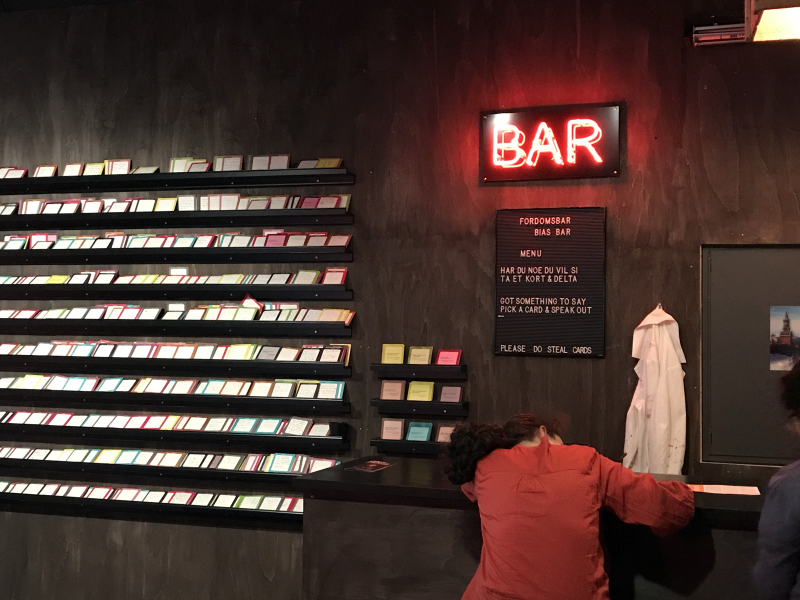
As we entered the main exhibit hall of Nobel Peace Center in Oslo last August, my eyes immediately noticed a sign that read BAR in one corner of the hall. Curious why would anyone need a drink to proceed further in the museum, I headed straight to the BAR. As I got closer, I noticed that it was really called BIAS BAR and that there were some cards on a nearby shelf. Two girls were sitting at the bar writing something inside the cards.
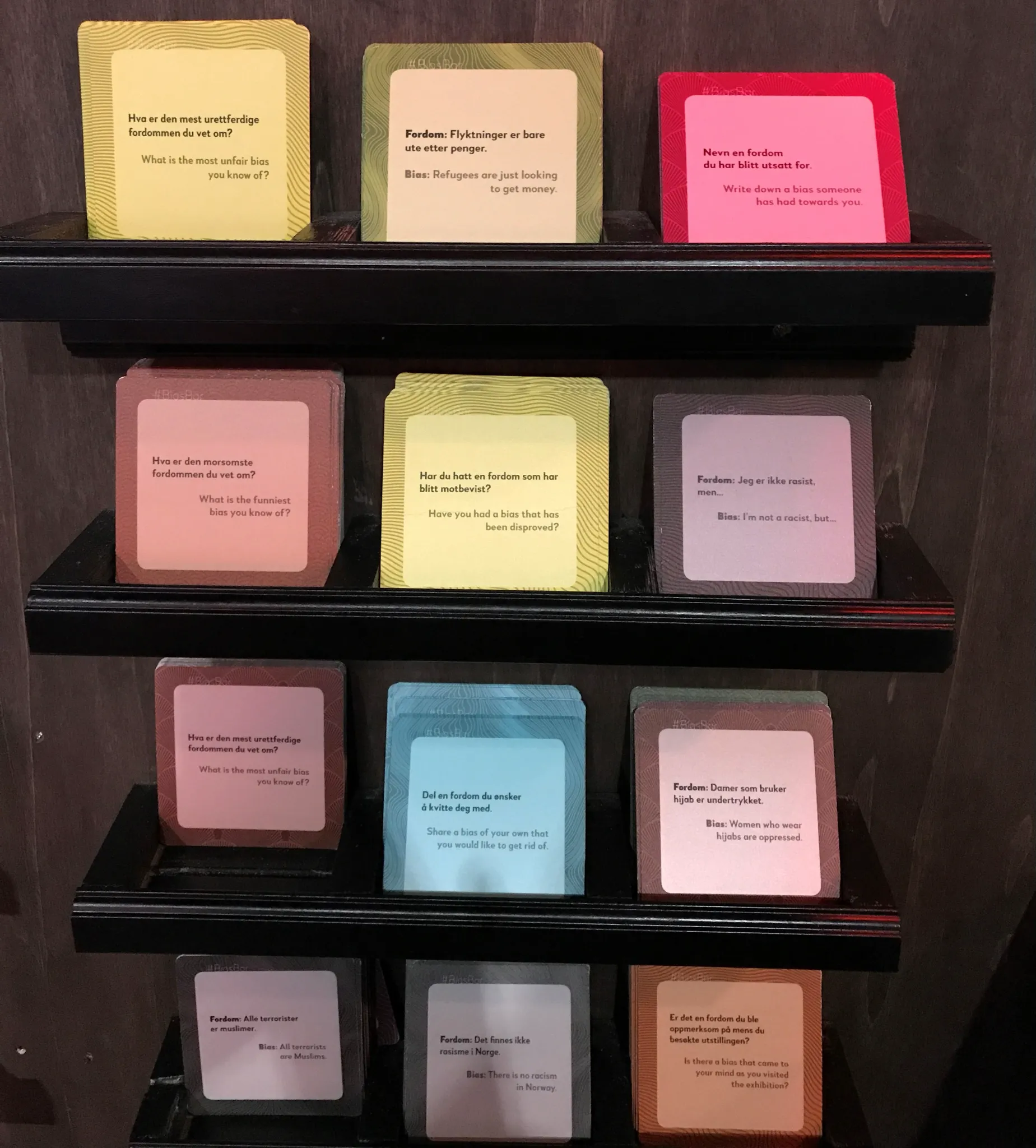
I immediately went to the smaller shelf and noticed twelve cards on them. One of them caught my eye. It read: Bias: Have you had a bias that has been disproved?
That specific card drew me into deep thought and a memory from my past resurfaced.
Our son is an actor and writer. Since he was young, my wife and I used to go to all of his plays and wait after the show to pat him on the back, appreciate what we liked, and give him a hug. Then one day we went to watch a play he was in San Francisco at the New Conservatory Theater. This play was about a young man who hates gay people and beats a gay man to death one drunken night in the park. The young man is arrested and convicted of a hate crime and sent to prison. While in jail the young man comes to terms with the motive of his hatred- that he is gay and could not deal or understand it. An inability to accept that part of himself manifests itself in violent and self-destructive actions. Our son played that young man struggling accepting those parts of himself. There were scenes in the play where our son had to portray that emotional conflict, that struggle, and we witnessed him kissing another man on stage. It was a hard hitting play in of itself, but even more unsettling in watching our only son embody that role.
When the play was over we waited in the hallway outside the lobby, by the stairs that would take us quickly out of the theater, I watched as he emerged from the theater with enthusiasm to meet us, as if the play hadn't left the same residue in him as it did with us; there was a joy in his face I couldn't fully understand. He looked around the lobby looking for us, a bit of that joy dissipating from not finding us there. Then he caught sight of us and noticed us standing on the stairs in the hallway, looking totally frozen. I could see the disappointment as he approached us. He asked, “You didn’t like the play, did you? Was I bad in the role? Do I need to work on some things?” I couldn't answer, I really couldn't find the words. I was shook up. He thanked us for coming and we said that we'd see him at home at that was really it, we left.
After a couple of days and having some time to reflect on what I had seen I had a talk with my son. I told him I couldn't understand why his character had to go through such a difficult turmoil. I told him it wasn't his performance but the play itself that bothered me. Then I asked him to quit the play. I reasoned that it was not a good play and that playing those types of characters could reflect poorly on my son as an actor- that he might even get typecast as playing only gay parts. I asked him if he wanted that stigma. It bothered me when he responded that he would be proud to play roles as complex and revealing as this one. He believed it was a play that begged for understanding and tolerance. And then he said what really scared me; he told me he didn't care what other people thought of him and didn't much care if people did think he was gay. He said that was their problem to bear, not his. I tried to reason with him, telling him I was only looking out for his best interests and that he was young and didn't understand what he was saying or doing or how the world really worked. I told him that he would see the truth in time.
My son did not quit that play. He kept performing even though now he had to do so in defiance to me but not really me, he was defiant to my prejudice. Still, I was his father and he continued, but with a shame that I had put in him and anchored in my profound disapproval. He did another play with that company shortly after, a lighter type comedy, but never worked with them again. I never thought much about it and to be quite honest at the time, I was relieved.
So many years have passed and the world has changed. My relationship to my son has changed. I have changed too. Standing at that Bias Bar in Oslo I wondered about that period in my life. I thought of my son. And that play. I had told him that with time he would see the truth. But I look back now and realize it was I that needed to see the truth all along.
Reflection:
Going back to the Bias BAR, I stood there for 30 minutes reading many notes. Many were about hidden prejudices, some achingly visible. It's easier to see and point out in others but very difficult to recognize in ourselves. We often don't look at them in that glaring way; we reason that they are our views, justifying them with our limited set of experiences and try to sell them to others as fact.
I still have a long way to go. There are still many times when our children and my friends call me out when I make what I think are innocent and simple statements; not fully knowing or understanding that I am harming others whose history and struggle I do not know or understand.
I leave you with the words of Maya Angelou:
"Prejudice is a burden that confuses the past, threatens the future and renders the present inaccessible."